Learn Common Question Words and Daily Conversations
Asking questions is one of the most important skills when learning any language. If you can ask simple questions, you can start conversations, learn new words, ask for help, and understand people better. In this lesson, you will learn the most common question words in Romanized Manipuri (Meiteilon) along with examples, useful daily conversations, and practice exercises.
Whether you are a beginner, traveler, student, or simply interested in learning Manipuri, this guide will help you become more confident in speaking Romanized Manipuri.
Why Learn Question Words?
Question words help you:
- Introduce yourself
- Ask someone’s name
- Find directions
- Buy things
- Order food
- Ask about time
- Learn new vocabulary
- Continue conversations naturally
Learning these words first makes everyday communication much easier.
Common Question Words
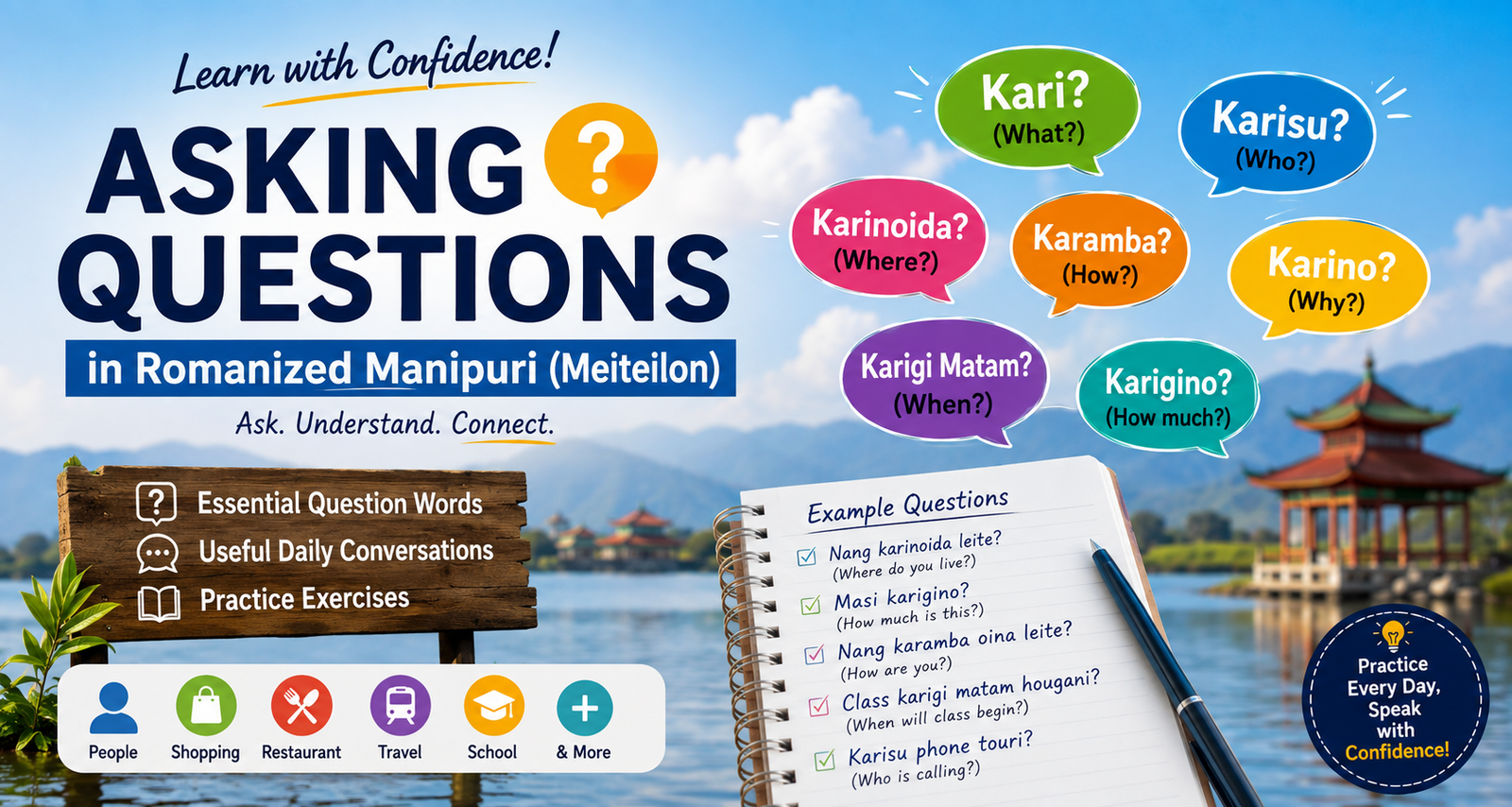
1. Kari? (What?)
Meaning: What?
Examples:
- Kari oirabano?
(What is it?) - Nangna kari toure?
(What are you doing?) - Masigi ming kari no?
(What is its name?) - Kari pamba?
(What do you want?)
2. Karino? (Why?)
Meaning: Why?
Examples:
- Karino nang lakliba?
(Why did you come?) - Karino nangna asumna hairi?
(Why are you saying that?) - Karino eigi phone pibiyu?
(Why did you give me the phone?)
3. Karigumba? (Which?)
Meaning: Which?
Examples:
- Karigumba lamda chatkani?
(Which road should we take?) - Karigumba book adu phangba ngamgani?
(Which book can I get?)
4. Karinoida? (Where?)
Meaning: Where?
Examples:
- Nang karinoida leite?
(Where do you live?) - School karinoida lei?
(Where is the school?) - Bus stand karinoida lei?
(Where is the bus stand?)
5. Karigi Matan? (When?)
Meaning: When?
Examples:
- Nang karigi matam lakkani?
(When will you come?) - Class karigi matam hougani?
(When will the class begin?)
6. Karisu? (Who?)
Meaning: Who?
Examples:
- Masi karisu?
(Who is this?) - Nanggi teacher karisu?
(Who is your teacher?) - Karisu phone touri?
(Who is calling?)
7. Karamba? (How?)
Meaning: How?
Examples:
- Nang karamba oina leite?
(How are you?) - Masi karamba tougani?
(How do we do this?) - Karamba chatkani?
(How should we go?)
8. Karigino? (How much?)
Meaning: How much?
Examples:
- Masi karigino?
(How much is this?) - Price karigino?
(How much does it cost?) - Ticket karigino?
(How much is the ticket?)
9. Karigisu? (How many?)
Meaning: How many?
Examples:
- Student karigisu lei?
(How many students are there?) - Book karigisu leire?
(How many books are there?)
Asking Personal Questions
Ming kari no?
(What is your name?)
Nang karinoida leite?
(Where do you live?)
Nanggi chakna kari?
(What is your favorite food?)
Nang schoolda chatre?
(Do you go to school?)
Nanggi phone number kari no?
(What is your phone number?)
Shopping Questions
Masi karigino?
(How much is this?)
Discount lei bra?
(Is there a discount?)
Asi kari oiba?
(What is this?)
Karigumba color lei?
(Which colors are available?)
Adubu henna leitabra?
(Do you have another one?)
Restaurant Questions
Menu lei bra?
(Do you have a menu?)
Chak kari lei?
(What food do you have?)
Eigi order lakpa kari matam?
(When will my order arrive?)
Ishing piba ngamdraba?
(Can I have some water?)
Bill pibiu.
(Please give me the bill.)
Travel Questions
Bus karinoida lei?
(Where is the bus?)
Airport karinoida lei?
(Where is the airport?)
Taxi phangba ngamdraba?
(Can I get a taxi?)
Karigumba road adu chatkani?
(Which road should I take?)
Map piba ngamdraba?
(Can you give me a map?)
School Questions
Teacher karisu?
(Who is the teacher?)
Class hougani karigi matam?
(When does class begin?)
Homework kari oiri?
(What is the homework?)
Exam karigi matam?
(When is the exam?)
Book piba ngamdraba?
(Can you give me the book?)
Asking for Help
Help toubiyu.
Eibu mateng pangbiyu.
Nangna eigi mateng pangba ngamdraba?
Police station karinoida lei?
Hospital karinoida lei?
Useful Question Sentences
Nang karamba oina leite?
Masi kari no?
Karisu lakle?
Karino chatli?
Karigi matam hougani?
Karigino oigani?
Karigisu leite?
Karinoida phanggani?
Karamba tougani?
Karigumba adu phanggani?
Mini Conversation
Person A: Nang karamba oina leite?
Person B: Ei phajare. Nangna?
Person A: Ei amasung phajare.
Person B: Nanggi ming kari no?
Person A: Eigi ming Rahul ni.
Person B: Nang karinoida leite?
Person A: Ei Imphalda leite.
Practice Exercise 1
Translate into Romanized Manipuri.
- What is your name?
- Where do you live?
- Who is your teacher?
- When will you come?
- How much is this?
Practice Exercise 2
Fill in the blanks.
- _______ no? (What?)
- _______ leite? (Where?)
- _______ lakkani? (When?)
- _______ oina leite? (How?)
- _______ ni? (Who?)
Practice Exercise 3
Answer in Romanized Manipuri.
- Nanggi ming kari no?
- Nang karinoida leite?
- Nangna kari pamba?
- Nang karamba oina leite?
- Nang schoolda chatre?
Learning Tips
- Practice five question words every day.
- Read each sentence aloud several times.
- Ask simple questions with friends or family.
- Create your own short conversations.
- Listen to native Manipuri speakers and repeat their questions.
- Keep a notebook of new question words and example sentences.
- Review your lessons regularly to improve fluency.
Question words are the foundation of everyday communication in Romanized Manipuri. Once you become comfortable asking simple questions like Kari? (What?), Karinoida? (Where?), Karisu? (Who?), Karamba? (How?), and Karigi Matam? (When?), you will be able to hold basic conversations with confidence.
Practice these questions every day, answer them aloud, and try using them in real-life situations. The more you ask questions, the faster you will improve your Romanized Manipuri speaking skills.
Happy Learning!
Learn Manipuri, Speak with Confidence!