Household Items in Romanized Manipuri (Meiteilon)
Learn Common Household Words with Example Sentences, Daily Conversations, and Practice Exercises
Learning the names of household items is an excellent way to improve your Romanized Manipuri (Meiteilon) vocabulary. We use these objects every day—at home, in the kitchen, in the bedroom, while cleaning, and when talking with family members.
If you are a beginner learning Manipuri, household vocabulary is especially useful because you can practice these words immediately. You can simply look around your home and name the things you see.
Why Learn Household Items in Manipuri?
Household vocabulary is useful for everyday communication.
By learning these words, you can:
- Describe things inside your home.
- Ask someone where an item is.
- Talk about cleaning and cooking.
- Understand simple conversations at home.
- Practice Manipuri while doing daily activities.
- Build your everyday vocabulary.
A simple way to learn is to choose five objects in your home every day and practice saying their names in Romanized Manipuri.
1. Rooms and Areas of the House
Before learning household objects, let’s learn a few common words related to the home.
| English | Romanized Manipuri |
|---|---|
| House / Home | Yum |
| Room | Ka |
| Kitchen | Chakshang |
| Bathroom | Bathroom |
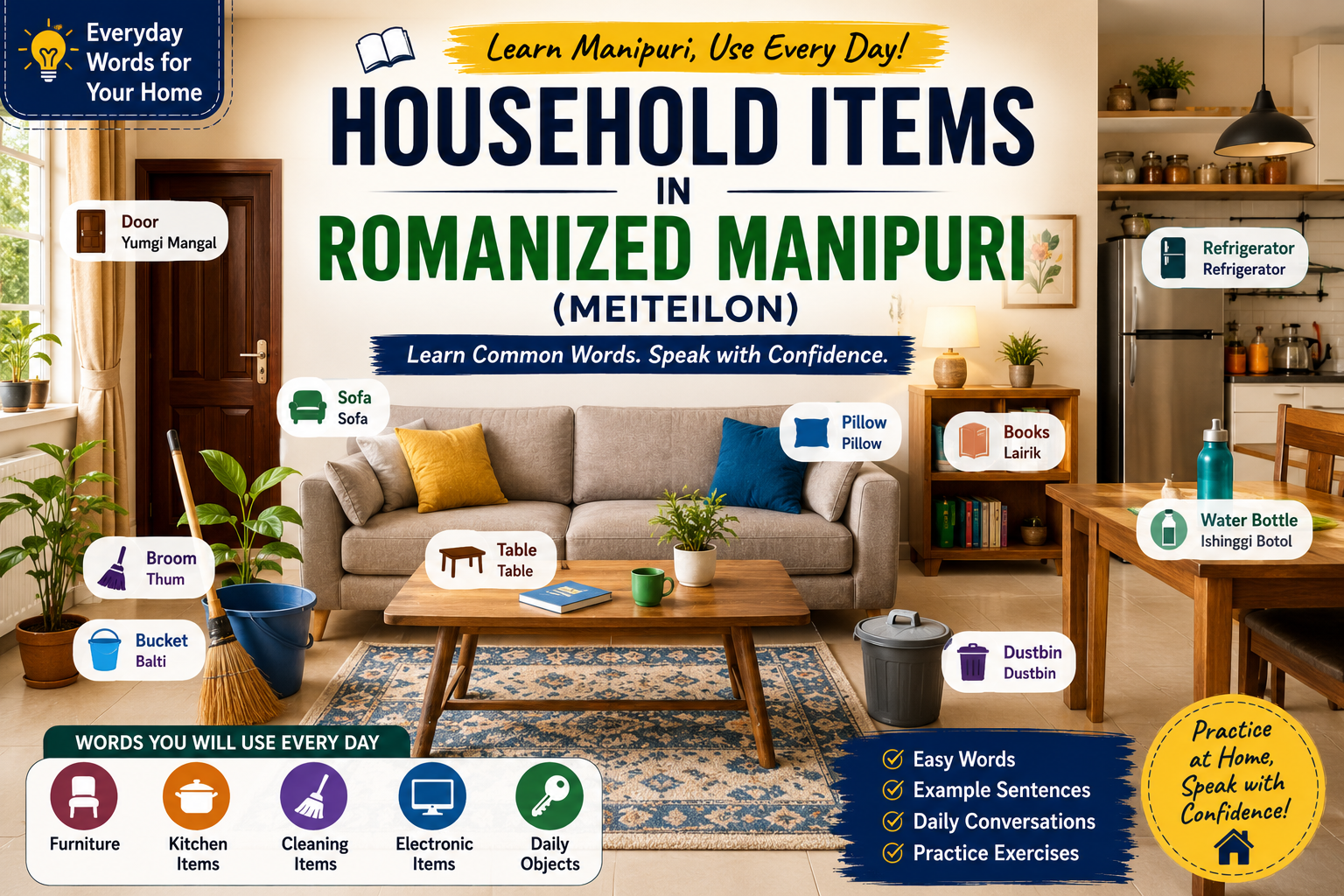
| Door | Yumgi mangal / Door |
| Window | Window |
| Floor | Floor |
| Roof | Yumgi mapan |
| Wall | Yumgi wall |
| Garden | Nongpok |
| Courtyard | Yumgi manung |
Some modern household terms are commonly borrowed from English in everyday speech, so you may hear both a Manipuri expression and an English-derived word depending on the speaker and situation.
2. Furniture
Furniture is one of the easiest categories to practice because you can find many of these things around your home.
| English | Romanized Manipuri |
|---|---|
| Chair | Chair |
| Table | Table |
| Bed | Bed |
| Sofa | Sofa |
| Bench | Bench |
| Cupboard | Almirah |
| Shelf | Shelf |
| Drawer | Drawer |
| Desk | Desk |
| Mirror | Aina |
| Mattress | Mattress |
| Pillow | Pillow |
| Blanket | Blanket |
Many everyday speakers use familiar borrowed words such as chair, table, bed, sofa, shelf, drawer, mattress, pillow, and blanket. This is normal in modern spoken language.
3. Kitchen Items
The kitchen is one of the best places to practice Manipuri vocabulary because there are many objects to name.
| English | Romanized Manipuri |
|---|---|
| Plate | Thali |
| Bowl | Bowl |
| Cup | Cup |
| Glass | Glass |
| Spoon | Spoon |
| Fork | Fork |
| Knife | Knife |
| Pot | Handa |
| Pan | Karahi |
| Bottle | Botol |
| Water bottle | Ishinggi botol |
| Cooking stove | Gas stove |
| Refrigerator | Refrigerator |
| Rice cooker | Rice cooker |
| Kettle | Kettle |
| Tray | Tray |
| Basket | Basket |
You may hear English loanwords frequently for modern kitchen appliances and utensils. This makes the vocabulary easier for beginners because the pronunciation is often familiar.
4. Cleaning Items
Cleaning is another useful topic for everyday conversations.
| English | Romanized Manipuri |
|---|---|
| Broom | Thum |
| Dustpan | Dustpan |
| Bucket | Balti |
| Mop | Mop |
| Brush | Brush |
| Soap | Sabun |
| Washing powder | Washing powder |
| Towel | Towel |
| Cloth | Puan |
| Dustbin | Dustbin |
5. Bedroom Items
Here are some common things you may find in a bedroom.
| English | Romanized Manipuri |
|---|---|
| Bed | Bed |
| Pillow | Pillow |
| Blanket | Blanket |
| Mattress | Mattress |
| Bedsheet | Bedsheet |
| Mirror | Aina |
| Cupboard | Almirah |
| Clothes | Phanek / Puan |
| Fan | Fan |
| Light | Light |
| Clock | Clock |
6. Electrical and Electronic Items
Modern homes contain many electronic items. Most of these words are commonly spoken using English loanwords.
| English | Romanized Manipuri |
|---|---|
| Fan | Fan |
| Light | Light |
| Bulb | Bulb |
| Television | TV |
| Radio | Radio |
| Mobile phone | Mobile |
| Computer | Computer |
| Laptop | Laptop |
| Refrigerator | Refrigerator |
| Washing machine | Washing machine |
| Charger | Charger |
| Remote control | Remote |
| Iron | Iron |
7. Bathroom Items
Here are some useful bathroom-related words.
| English | Romanized Manipuri |
|---|---|
| Soap | Sabun |
| Shampoo | Shampoo |
| Towel | Towel |
| Bucket | Balti |
| Mug | Mug |
| Toothbrush | Toothbrush |
| Toothpaste | Toothpaste |
| Comb | Kangna |
| Mirror | Aina |
| Water | Ishing |
8. Common Household Objects
Let’s learn some more objects that you may see around your home.
| English | Romanized Manipuri |
|---|---|
| Key | Chabi |
| Lock | Lock |
| Bag | Bag |
| Box | Box |
| Bottle | Botol |
| Umbrella | Chhatri |
| Clock | Clock |
| Calendar | Calendar |
| Book | Lairik |
| Pen | Pen |
| Paper | Paper |
| Scissors | Scissors |
| Rope | Phur |
| Basket | Basket |
Example Sentences
Now let’s use some household vocabulary in simple sentences.
1. This is my house.
Masi eigi yum ni.
This is my house.
2. The chair is in the room.
Chair adu kada lei?
Where is the chair?
3. Where is the key?
Chabi adu kada lei?
Where is the key?
4. The book is on the table.
Lairik adu table-da lei.
The book is on the table.
5. Please bring the chair.
Chair adu pullo.
Please bring the chair.
6. Please give me the bottle.
Botol adu pibi.
Please give me the bottle.
7. Where is the broom?
Thum adu kada lei?
Where is the broom?
8. Bring the bucket.
Balti adu purak-u.
Bring the bucket.
9. The food is in the kitchen.
Chak adu chakshang-da lei.
The food is in the kitchen.
10. The fan is working.
Fan asi thabak toure.
The fan is working.
Talking About Things at Home
You can use simple questions to practice household vocabulary.
Question:
Masi kari no?
What is this?
Answer:
Masi table ni.
This is a table.
Question:
Adu kada lei?
Where is that?
Answer:
Adu room-da lei.
It is in the room.
Question:
Chabi kada lei?
Where is the key?
Answer:
Chabi table-da lei.
The key is on the table.
Daily Conversation 1: Looking for a Key
Person A: Chabi adu kada lei?
Person B: Table-da lei.
Person A: Table kada lei?
Person B: Room-da lei.
Person A: Hou, thagatchari!
English Meaning
Person A: Where is the key?
Person B: It is on the table.
Person A: Where is the table?
Person B: It is in the room.
Person A: Okay, I found it!
Daily Conversation 2: Cleaning the House
Person A: Yum seng-u?
Person B: Hou, seng-i.
Person A: Thum kada lei?
Person B: Thum adu kitchen-da lei.
Person A: Balti adu pibi.
Person B: Hou, pibi.
English Meaning
Person A: Are you cleaning the house?
Person B: Yes, I am cleaning it.
Person A: Where is the broom?
Person B: The broom is in the kitchen.
Person A: Please give me the bucket.
Person B: Okay, I’ll give it to you.
Daily Conversation 3: In the Kitchen
Person A: Chak toure?
Person B: Hou, chak toure.
Person A: Alu kada lei?
Person B: Kitchen-da lei.
Person A: Knife adu pibi.
Person B: Hou, pibi.
English Meaning
Person A: Are you cooking?
Person B: Yes, I am cooking.
Person A: Where are the potatoes?
Person B: They are in the kitchen.
Person A: Please give me the knife.
Person B: Okay, here you are.
Useful Household Sentences
Practice these sentences every day:
Yum seng-u.
Clean the house.
Door adu hang-u.
Open the door.
Door adu thang-u.
Close the door.
Light adu hang-u.
Turn on the light.
Light adu thang-u.
Turn off the light.
Fan adu hang-u.
Turn on the fan.
Fan adu thang-u.
Turn off the fan.
Chabi adu pibi.
Please give me the key.
Botol adu pibi.
Please give me the bottle.
Lairik adu table-da lei.
The book is on the table.
Practice Exercise 1: Match the Words
Match the English word with the Romanized Manipuri word.
- House → _______
- Book → _______
- Water → _______
- Key → _______
- Broom → _______
- Mirror → _______
Choices:
- Aina
- Yum
- Chabi
- Lairik
- Ishing
- Thum
Practice Exercise 2: Fill in the Blanks
Choose the correct word.
- Masi eigi _______ ni.
(house) - Lairik adu _______-da lei.
(table) - _______ adu kada lei?
(key) - Yum _______-u.
(clean) - Ishing adu _______-da lei.
(bottle)
Practice Exercise 3: Translate into Romanized Manipuri
Translate these sentences.
- This is my house.
- Where is the key?
- The book is on the table.
- Please bring the bucket.
- Clean the house.
- Where is the broom?
- Please give me the bottle.
- The food is in the kitchen.
Practice Exercise 4: Translate into English
Translate the following sentences.
- Masi eigi yum ni.
- Chabi adu kada lei?
- Lairik adu table-da lei.
- Thum adu kitchen-da lei.
- Botol adu pibi.
- Yum seng-u.
Practice Exercise 5: Look Around Your Home
This is a simple exercise you can do every day.
Look around your room and choose five objects.
For example:
- Table
- Chair
- Book
- Bottle
- Fan
Now say a simple sentence about each object.
For example:
Masi table ni.
This is a table.
Lairik adu table-da lei.
The book is on the table.
Try creating five sentences every day.
Mini Speaking Practice
Ask yourself these questions while walking around your home:
Masi kari no?
What is this?
Adu kada lei?
Where is that?
Chabi kada lei?
Where is the key?
Lairik kada lei?
Where is the book?
Botol kada lei?
Where is the bottle?
Answer each question in Romanized Manipuri.
This simple activity can turn your home into your own Manipuri classroom.
Household Vocabulary Challenge
Try to learn these ten words first:
- Yum – House
- Ka – Room
- Lairik – Book
- Chabi – Key
- Aina – Mirror
- Thum – Broom
- Ishing – Water
- Table – Table
- Chair – Chair
- Botol – Bottle
Once you remember these, add five more words.
Learning a small number of words every day is much easier than trying to memorize everything at once.
Tips to Remember Household Vocabulary
1. Use objects around you
Do not only read the vocabulary list. Look at the actual object while saying its name.
2. Speak aloud
Reading silently can help you recognize words, but speaking aloud helps you become comfortable using them.
3. Make short sentences
Instead of memorizing only lairik, practice:
Lairik adu table-da lei.
4. Practice with family
Ask someone at home simple questions such as:
Chabi adu kada lei?
5. Review regularly
Spend five minutes each day reviewing old vocabulary before learning new words.
Quick Vocabulary Review
Around the House
- Yum – House
- Ka – Room
- Lairik – Book
- Chabi – Key
- Aina – Mirror
- Puan – Cloth
- Ishing – Water
Furniture
- Table – Table
- Chair – Chair
- Bed – Bed
- Sofa – Sofa
- Almirah – Cupboard
- Shelf – Shelf
- Drawer – Drawer
Kitchen
- Chakshang – Kitchen
- Thali – Plate
- Handa – Pot
- Karahi – Pan
- Botol – Bottle
- Cup – Cup
- Glass – Glass
- Spoon – Spoon
Cleaning
- Thum – Broom
- Balti – Bucket
- Sabun – Soap
- Brush – Brush
- Puan – Cloth
Electronics
- Fan – Fan
- Light – Light
- TV – Television
- Mobile – Mobile phone
- Computer – Computer
- Refrigerator – Refrigerator
Learning Household Items in Romanized Manipuri is a simple and practical way to expand your everyday vocabulary. You do not need to travel anywhere or find special study materials—you can practice using the objects already around you.
Start with a few words such as yum, ka, lairik, chabi, aina, thum, and ishing. Then gradually add furniture, kitchen items, cleaning tools, and electronic devices.
Remember that some modern household words are commonly spoken using English loanwords in everyday Meiteilon. The goal for beginners is not to memorize hundreds of words at once, but to understand and use useful vocabulary naturally.
Practice the example sentences, try the conversations with a friend or family member, and complete the exercises regularly.
The more you use Romanized Manipuri in everyday situations, the more naturally the language will become part of your daily life.
Learn. Practice. Speak Manipuri with Confidence!