How to Introduce Yourself in Manipuri (Meiteilon):
Learning how to introduce yourself is one of the first useful skills when learning a new language. Whether you are meeting someone for the first time, visiting Manipur, talking with friends, or simply practicing Manipuri (Meiteilon), knowing a few basic self-introduction sentences can help you start a conversation with confidence.
1. Saying Hello in Manipuri
A conversation usually starts with a greeting.
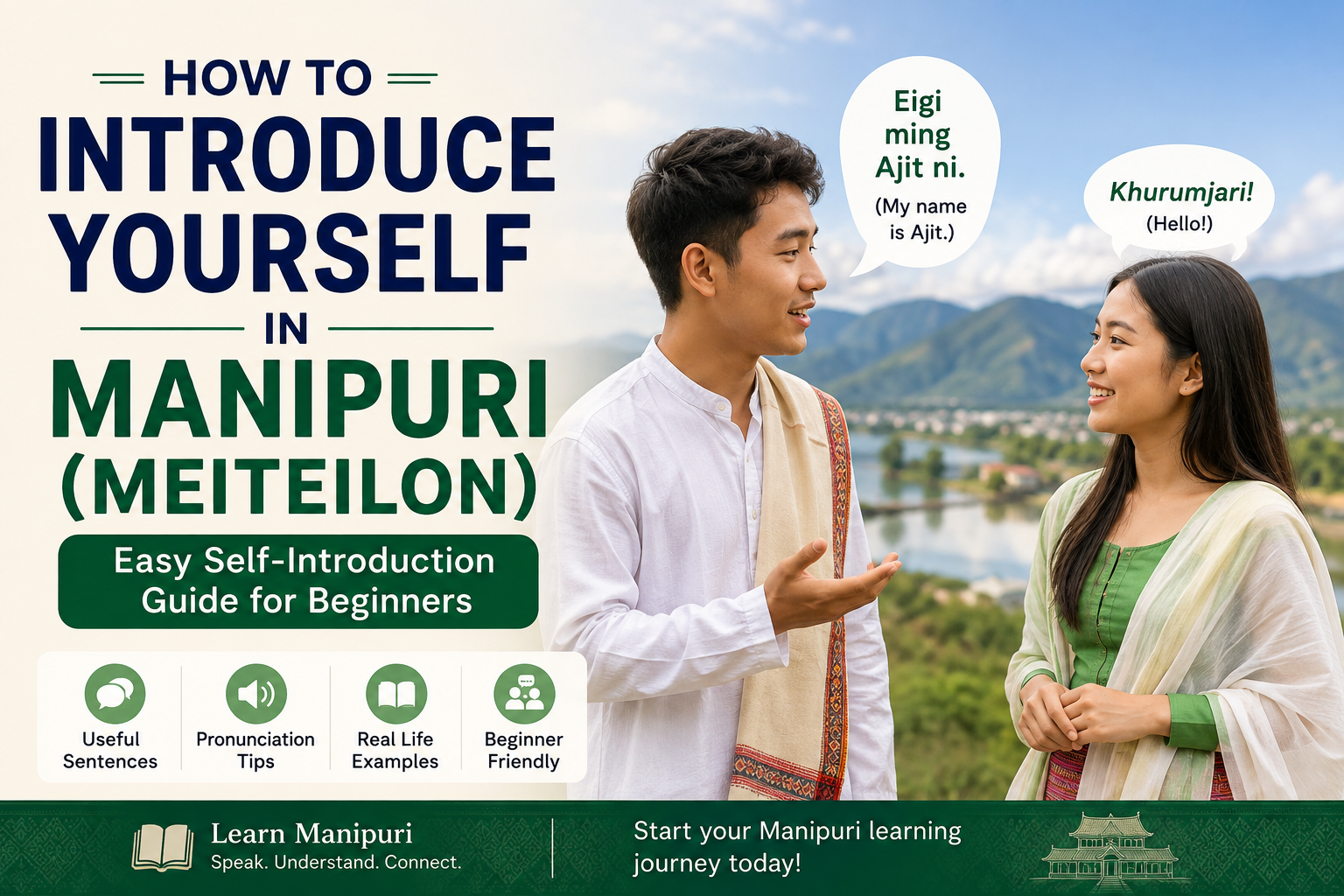
Khurumjari!
Meaning:
Hello / Greetings
You can use this as a polite greeting when meeting someone.
2. Saying “My Name Is…”
One of the most important sentences to learn is how to tell someone your name.
Eigi ming ___ ni.
Meaning:
My name is ___.
For example:
Eigi ming Ajit ni.
Meaning:
My name is Ajit.
Here:
- Eigi = my
- ming = name
- ni = is
This is a simple sentence pattern that beginners can practice with their own name.
3. Asking Someone’s Name
After introducing yourself, you may want to ask the other person’s name.
Nahakki ming kari?
Meaning:
What is your name?
You can use this sentence when meeting someone for the first time.
Example
Person A: Eigi ming Ajit ni.
Person B: Eigi ming Rina ni.
You can then continue the conversation by asking about where the person lives or comes from.
4. Saying Where You Are From
You may want to tell someone where you are from.
A useful sentence pattern is:
Eina ___-dagi lak-i.
Meaning:
I come from ___.
Replace the place name with your hometown or village.
For example, you can practice by inserting your own place:
Eina Imphal-dagi lak-i.
Meaning:
I come from Imphal.
Learning this pattern makes it easier to talk about yourself.
5. Saying Where You Live
You can also tell someone where you live.
Eina ___-da leiri.
Meaning:
I live in ___.
For example:
Eina Imphal-da leiri.
Meaning:
I live in Imphal.
This is useful when talking to someone who wants to know where you live.
6. Saying Your Occupation
You may also want to tell someone what you do.
For example, you can introduce yourself as a student.
Eina student-ni.
Meaning:
I am a student.
If you work, you can adapt the sentence to describe your occupation.
The important thing for beginners is to learn the sentence structure and then practice replacing the occupation with your own.
7. Talking About Your Family
After introducing yourself, conversations often move toward family.
You can say:
Eigi yumda ___ nupi/nupa leiri.
The exact wording can depend on what you want to describe, so beginners should learn family vocabulary separately and then combine those words into sentences.
For example, learn words for:
- Father
- Mother
- Brother
- Sister
- Husband
- Wife
- Son
- Daughter
Once you know these words, you can start building simple sentences about your family.
8. A Simple Self-Introduction in Manipuri
Now let’s put the ideas together.
Romanized Manipuri
Khurumjari!
Eigi ming Ajit ni.
Eina Imphal-dagi lak-i.
Eina Imphal-da leiri.
Eina student-ni.
English
Hello!
My name is Ajit.
I come from Imphal.
I live in Imphal.
I am a student.
The sentences can be changed to match your own name, hometown and occupation.
9. Useful Questions When Meeting Someone
Once you can introduce yourself, you can keep the conversation going.
Here are some useful things to learn:
| English | Romanized Manipuri |
|---|---|
| What is your name? | Nahakki ming kari? |
| My name is… | Eigi ming … ni. |
| Where do you come from? | Nahak kada-dagi laklibano? |
| Where do you live? | Nahak kada-da leibano? |
| What do you do? | Nahak kari toujari? |
Practice saying these sentences aloud rather than simply reading them.
10. A Short Manipuri Conversation
Here is a simple example for beginners.
A: Khurumjari!
B: Khurumjari!
A: Nahakki ming kari?
B: Eigi ming Rina ni. Nahakki?
A: Eigi ming Ajit ni.
B: Nahak kada-dagi laklibano?
A: Eina Imphal-dagi lak-i.
This type of short conversation is much more useful than memorizing individual words because it teaches you how vocabulary works together in real communication.
11. Practice Your Own Introduction
Now try writing your own introduction.
Use this pattern:
Khurumjari!
Eigi ming ______ ni.
Eina ______-dagi lak-i.
Eina ______-da leiri.
Eina ______-ni.
Fill in the blanks with:
- Your name
- Your hometown
- Where you live
- Your occupation
Then read your introduction aloud several times.
12. Why Learn Self-Introduction First?
Self-introduction is one of the most practical skills for a beginner because it gives you a foundation for many other conversations.
Once you can introduce yourself, you can start learning how to:
- Ask someone’s name
- Talk about your family
- Talk about your hometown
- Talk about your work
- Talk about your hobbies
- Ask simple questions
- Have short everyday conversations
Instead of memorizing isolated vocabulary, you begin learning how to communicate.
Learning Manipuri becomes easier when you start using words in complete sentences.
Don’t worry about memorizing everything in one day. Start with your name, where you are from, where you live and what you do. Practice these sentences until they feel natural.
Then gradually add more vocabulary and longer conversations.
Start small. Practice every day. And use Manipuri whenever you get the opportunity.
Continue Learning
If you’re learning Manipuri through Romanized Meiteilon, continue with lessons on:
- Everyday Manipuri phrases
- Manipuri question words
- Numbers in Manipuri
- Colors and animals
- Body parts
- Manipuri pronunciation
- Common Manipuri vocabulary
Your next goal: Try introducing yourself in Manipuri without looking at the examples above.