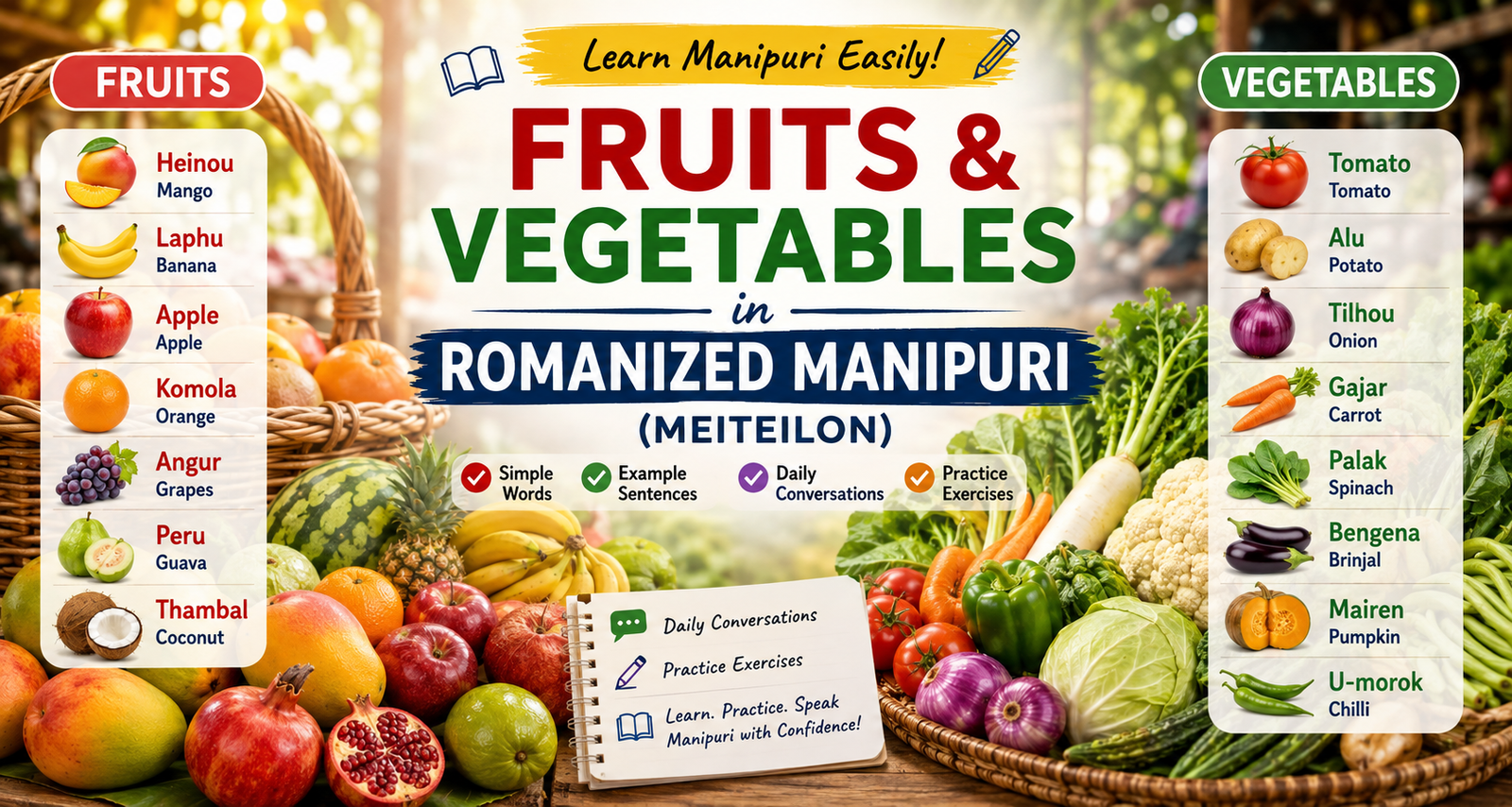
Learn Common Fruits and Vegetables with Everyday Vocabulary, Example Sentences, Daily Conversations, and Practice Exercises
Learning the names of fruits and vegetables is an important step in building your Romanized Manipuri (Meiteilon) vocabulary. These are words you will hear every day at home, in the market, at restaurants, and while talking with family and friends.
Whether you are a student, traveler, or someone learning Manipuri for the first time, this guide will help you improve your everyday communication.
Why Learn Fruits & Vegetables?
Learning these words will help you:
- Buy food at the market.
- Order fruits and vegetables confidently.
- Talk about healthy eating.
- Understand daily conversations.
- Build a stronger Manipuri vocabulary.
Common Fruits (Romanized Manipuri)
| English | Romanized Manipuri |
|---|---|
| Mango | Heinou |
| Banana | Laphu |
| Apple | Apple |
| Orange | Komola |
| Pineapple | Anaras |
| Papaya | Awathabi |
| Watermelon | Tarbuj |
| Grapes | Angur |
| Guava | Peru |
| Lemon | Champra |
| Coconut | Thambal |
| Pomegranate | Dalim |
| Strawberry | Strawberry |
| Pear | Nashpati |
| Jackfruit | Theibong |
Common Vegetables (Romanized Manipuri)
| English | Romanized Manipuri |
|---|---|
| Potato | Alu |
| Tomato | Tomato |
| Onion | Tilhou |
| Garlic | Ust |
| Ginger | Shing |
| Cabbage | Bandhakopi |
| Cauliflower | Phulkopi |
| Carrot | Gajar |
| Cucumber | Thambou |
| Pumpkin | Mairen |
| Brinjal (Eggplant) | Bengena |
| Chilli | U-morok |
| Spinach | Palak |
| Beans | Bean |
| Peas | Motor |
| Radish | Mula |
| Bottle Gourd | Lau |
| Bitter Gourd | Karathei |
Example Sentences
Fruits
Ei heinou pammi.
(I like mangoes.)
Ei laphu cha-i.
(I am eating a banana.)
Apple asi nungairi.
(This apple is delicious.)
Komola asi asengba ni.
(This orange is fresh.)
Ei angur khara leire.
(I have some grapes.)
Vegetables
Ei alu leire.
(I have potatoes.)
Tilhou asi achouba ni.
(This onion is big.)
Tomato asi asengba ni.
(This tomato is fresh.)
Palak cha-ba phajai.
(Eating spinach is good.)
U-morok asi nungairi.
(This chilli is tasty.)
Useful Market Vocabulary
- Keithel – Market
- Mana kari no? – What is the price?
- Karigino? – How much?
- Asi pibiyu. – Please give me this.
- Henna lei bra? – Do you have more?
- Asengba – Fresh
- Phajaba – Good
- Chaba – To eat
- Leire – There is / I have
Daily Conversation 1 – Buying Fruits
Customer:
Eibu heinou khara pibiyu.
Seller:
Hou, karigino pambi?
Customer:
Kilogram ama pibiyu.
Seller:
Houjik pibi.
English Translation
Customer:
Please give me some mangoes.
Seller:
Sure. How many do you want?
Customer:
Please give me one kilogram.
Seller:
Here you are.
Daily Conversation 2 – Buying Vegetables
Customer:
Tomato amasung alu lei bra?
Seller:
Lei.
Customer:
Karigino?
Seller:
Tomato kilogram amada ₹40.
Alu kilogram amada ₹30.
Customer:
Hou, kilogram ama ama pibiyu.
English Translation
Customer:
Do you have tomatoes and potatoes?
Seller:
Yes.
Customer:
How much are they?
Seller:
Tomatoes are ₹40 per kilogram.
Potatoes are ₹30 per kilogram.
Customer:
Please give me one kilogram of each.
Useful Everyday Sentences
Ei fruits cha-i.
(I eat fruits.)
Ei vegetables cha-i.
(I eat vegetables.)
Apple asi phajai.
(This apple tastes good.)
U-morok asi yai.
(This chilli is spicy.)
Heinou asi nungairi.
(The mango is delicious.)
Eigi ima keithelda chatli.
(My mother is going to the market.)
Healthy Eating Vocabulary
Fruits chaba phajai.
(Eating fruits is healthy.)
Vegetables chaba phajai.
(Eating vegetables is good.)
Ishing yam thaj-u.
(Drink plenty of water.)
Healthy chak cha-u.
(Eat healthy food.)
Practice Exercise 1
Match the words.
Apple → _______
Potato → _______
Banana → _______
Tomato → _______
Onion → _______
Choices:
Tilhou
Apple
Tomato
Laphu
Alu
Practice Exercise 2
Fill in the blanks.
- Ei _______ cha-i. (Banana)
- Tomato asi _______ ni. (Fresh)
- Ei _______ pammi. (Mango)
- Alu amasung _______ leire. (Onion)
- Fruits _______ phajai. (Eating)
Practice Exercise 3
Translate into Romanized Manipuri.
- I like mangoes.
- Please give me some tomatoes.
- This apple is fresh.
- How much is one kilogram?
- We are going to the market.
Practice Exercise 4
Answer in Romanized Manipuri.
- Nangna kari pammi?
- Nangna fruits cha-bra?
- Keithel karinoida lei?
- Tomato karigino?
- Kari vegetable nangna nungairi?
Vocabulary Review
Fruits
- Heinou – Mango
- Laphu – Banana
- Apple – Apple
- Komola – Orange
- Anaras – Pineapple
- Awathabi – Papaya
- Tarbuj – Watermelon
- Angur – Grapes
- Peru – Guava
- Champra – Lemon
- Thambal – Coconut
- Dalim – Pomegranate
- Theibong – Jackfruit
Vegetables
- Alu – Potato
- Tomato – Tomato
- Tilhou – Onion
- Ust – Garlic
- Shing – Ginger
- Gajar – Carrot
- Palak – Spinach
- U-morok – Chilli
- Bengena – Brinjal
- Mairen – Pumpkin
- Mula – Radish
- Lau – Bottle Gourd
- Karathei – Bitter Gourd
Tips for Learning
- Learn five new fruit or vegetable names every day.
- Practice saying each word aloud several times.
- Visit a local market and identify the items in Romanized Manipuri.
- Use the words in simple daily conversations.
- Review the vocabulary every week and test yourself regularly.
Fruits and vegetables are part of our daily lives, making them some of the most useful words to learn in Romanized Manipuri. By practicing the vocabulary, reading the example sentences, and completing the exercises in this lesson, you will be able to talk about food, shop at the market, and have simple conversations with confidence.
Keep practicing a little every day, and your Romanized Manipuri vocabulary will continue to grow. The more words you use in real conversations, the more natural speaking Manipuri will become.
Happy Learning! Learn Manipuri One Word at a Time.