Everyday Phrases in Romanized Manipuri
Learning everyday phrases is one of the easiest and fastest ways to communicate in Manipuri (Meiteilon). Whether you are visiting Manipur, talking with Manipuri friends, or simply learning the language for fun, knowing common daily expressions will help you speak naturally and confidently.
In this lesson, you will learn useful Everyday Phrases in Romanized Manipuri along with their English meanings. Practice these phrases every day, and you will quickly improve your conversation skills.
Why Learn Everyday Phrases?
Instead of memorizing difficult grammar rules, learning common phrases allows you to start speaking immediately. Native speakers use these expressions every day in homes, markets, schools, workplaces, and while meeting friends.
Daily practice helps you:
- Improve pronunciation
- Build confidence
- Understand conversations faster
- Speak naturally
- Expand your vocabulary
Now let’s begin with the most useful phrases.
Greetings
Hello
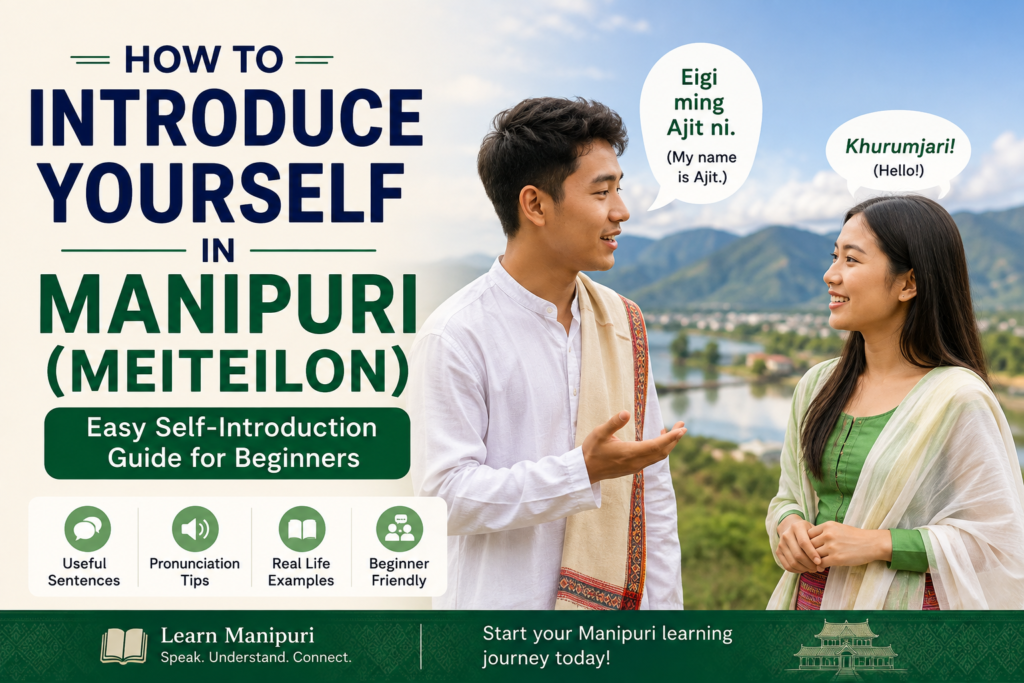
Khurumjari
Good Morning
Nongaleigi Khurumjari
Good Afternoon
Numitki Khurumjari
Good Evening
Nongphai Khurumjari
Good Night
Athengba Numit Oina Chatlu
Welcome
Karigumba Nungairaba
How are you?
Adom Kari Oiribano?
I am fine.
Ei Yamlaba Oire.
Nice to meet you.
Adubu Nangi Lanna Uba Yamnna Nungairi.
See you later.
Matam Amada Ugani.
Goodbye
Chatcharage.
Polite Expressions
Thank you
Thagatchari
Thank you very much
Yamna Thagatchari
You’re welcome
Karino.
Please
Chanbiduna
Excuse me
Nungsibiyu
Sorry
Sige
No problem
Karino Oi
It’s okay
Yade
I understand.
Ei Khang-i.
I don’t understand.
Ei Khangde.
Introducing Yourself
My name is…
Eigi Mingna…
What is your name?
Nangi Ming Kari No?
I am from Manipur.
Ei Manipurdagi Lak-i.
Where are you from?
Nang Karadagi Laklibano?
I am a student.
Ei Student Amani.
I work here.
Ei Mapham Asida Thabak Tou-i.
Nice to meet you.
Uba Yamnna Nungairi.
Daily Conversation
What are you doing?
Nang Kari Touribano?
I am eating.
Ei Chak Chari.
I am drinking water.
Ei Ishing Thari.
I am going.
Ei Chatli.
I am coming.
Ei Lakli.
Wait a moment.
Khudong Chaba Amuk Ngaak-u.
Come here.
Masida Lak-u.
Sit down.
Pham-u.
Stand up.
Leplu.
Let’s go.
Chatminnasi.
Asking Questions
Where?
Kari Maphamda?
When?
Karigi Matamda?
Why?
Karigino?
Who?
Kanano?
Which?
Karino?
How?
Kari Oina?
Can you help me?
Eibu Tengbang Pirak-u?
Can you repeat?
Amuk Hairak-u.
Please speak slowly.
Khudakta Hairak-u.
At Home
I’m home.
Ei Yumda Lakle.
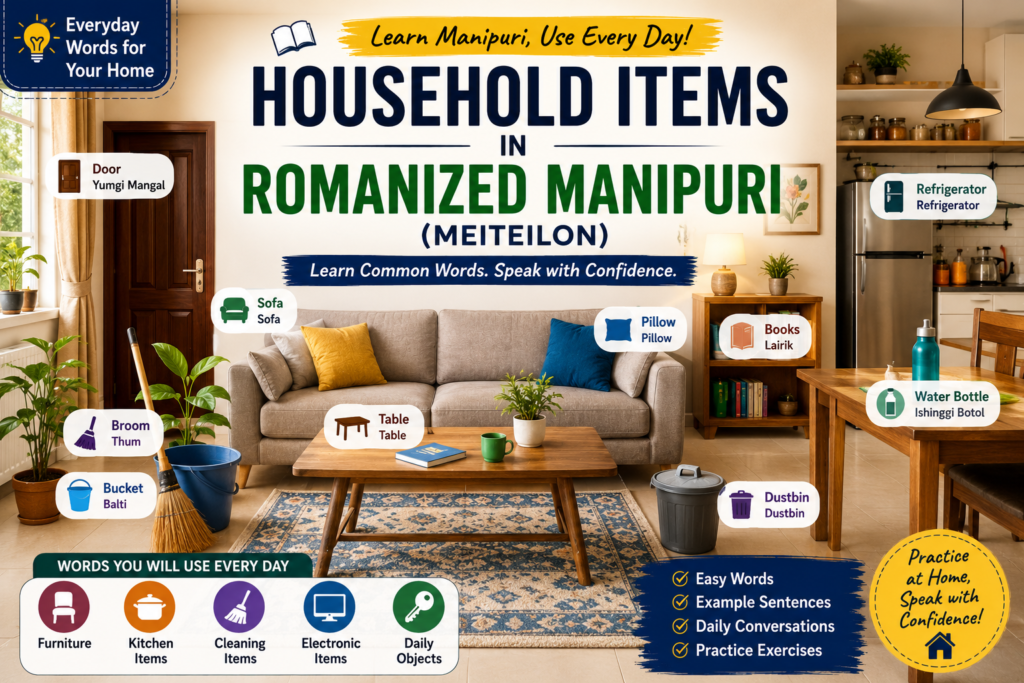
Open the door.
Thong Hang-u.
Close the door.
Thong Loiduna Thing-u.
Turn on the light.
Mei Hang-u.
Turn off the light.
Mei Thing-u.
Let’s eat.
Chak Chaminnasi.
The food is delicious.
Chak Asi Yamnna Hennaba Ni.
I am hungry.
Ei Chak Charoi.
I am thirsty.
Ei Ishing Tharai.
At School
Good morning teacher.
Teacher, Nongaleigi Khurumjari.
May I come in?
Ei Nungsina Lakpa Yagadra?
I have a question.
Eigi Wahang Ama Lei.
I understand.
Ei Khang-i.
I don’t understand.
Ei Khangde.
Please explain again.
Amuk Sandok-u.
Thank you teacher.
Teacher, Thagatchari.
At the Market
How much is this?
Masi Kari Mano?
It’s expensive.
Masi Mari Leiri.
It’s cheap.
Masi Mari Yamde.
Can you reduce the price?
Mari Hanthokpa Yagadra?
I want this.
Ei Masi Pammi.
Give me one.
Ama Piru.
Give me two.
Ani Piru.
I don’t need it.
Ei Darkar Leite.
Traveling
Where is the bus stop?
Bus Lepliba Mapham Karino?
Where is the airport?
Airport Karino?
Where is the hotel?
Hotel Karino?
I need a taxi.
Taxi Ama Darkar Oi.
Please stop here.
Masida Leppu.
How far is it?
Masi Kayam Chaoba No?
Thank you.
Thagatchari.
Talking with Friends
How have you been?
Nang Kari Oiribano?
I’m happy.
Ei Yamnna Nungairi.
Congratulations.
Yamna Yumpham Oi.
Good luck.
Mapung Phana Oi-u.
Have a nice day.
Numit Adu Nungairaga Chat-u.
Let’s meet tomorrow.
Hayeng Uminnasi.
Call me.
Eibu Phone Tou-u.
See you soon.
Karigi Matam Amada Ugani.
Useful Emergency Phrases
Help!
Tengbang-u!
Call the police.
Police Kou-u.
Call a doctor.
Doctor Kou-u.
I need help.
Ei Tengbang Darkar Oi.
Where is the hospital?
Hospital Karino?
I am sick.
Ei Naba Oire.
Please help me.
Chanbiduna Tengbang Piru.
Talking About Time
Today
Ngasi
Tomorrow
Hayeng
Yesterday
Hiyang
Now
Houjik
Later
Matungda
Morning
Nongalei
Afternoon
Numit Mayam
Evening
Nongphai
Night
Athengba
Common Daily Expressions
- Ei Nungairi. – I am happy.
- Ei Pammi. – I like it.
- Ei Pamde. – I don’t like it.
- Houjik Chatli. – I’m leaving now.
- Houjik Lakli. – I’m coming now.
- Nungsibiyu. – Excuse me.
- Karino. – You’re welcome.
- Thagatchari. – Thank you.
- Sige. – Sorry.
- Yade. – It’s okay.
- Ei Khangde. – I don’t know.
- Ei Khang-i. – I know.
- Amuk Hairak-u. – Say it again.
- Khudakta Hairak-u. – Speak slowly.
- Masida Lak-u. – Come here.
- Chat-u. – Go.
- Pham-u. – Sit.
- Leplu. – Stand up.
- Ngaak-u. – Wait.
- Chatminnasi. – Let’s go together.
Tips for Learning Romanized Manipuri
Learning Romanized Manipuri becomes easier when you practice every day. Read each phrase aloud several times. Listen carefully to native speakers and repeat after them. Try using these expressions in real conversations with friends or family members.
Writing the phrases in a notebook also helps improve memory. Learn five to ten new phrases each day instead of trying to memorize everything at once. Watching Manipuri videos, listening to songs, and reading simple conversations will improve your pronunciation and understanding.
Don’t be afraid of making mistakes. Every learner starts with simple greetings and everyday expressions before becoming fluent. Consistency is much more important than perfection.
Everyday phrases are the foundation of learning Romanized Manipuri. By mastering these common expressions, you will be able to greet people, ask questions, shop, travel, make friends, and handle daily conversations with greater confidence.
Practice these phrases regularly, use them whenever you have the opportunity, and gradually expand your vocabulary. The more you speak, the more natural Manipuri will become.
Happy learning!
Thagatchari!