Everyday Phrases in Manipuri (Romanized Meiteilon)
Everyday phrases are one of the fastest ways to start speaking Manipuri confidently. Instead of learning single words, you can use complete phrases in real-life conversations. Whether you’re greeting someone, asking for help, shopping, or talking with family and friends, these common expressions will help you communicate naturally.
Below are some of the most useful everyday Manipuri phrases written in Romanized Meiteilon, along with their English meanings.
Basic Greetings
| English | Romanized Manipuri |
|---|---|
| Hello | Khurumjari |
| Good Morning | Nongalei Kari Oirabadi Khurumjari |
| Good Evening | Numitlei Khurumjari |
| Welcome | Loushingbiyu |
| How are you? | Nang karamna leire? |
| I am fine. | Ei phajare. |
| Nice to meet you. | Nangbu uba nungshibani. |
| Goodbye | Chatnaba |
| See you again. | Amuk unagani. |
Polite Expressions
| English | Romanized Manipuri |
|---|---|
| Thank you | Thagatchari |
| Thank you very much | Yamna thagatchari |
| You’re welcome | Karigumba natte |
| Please | Chanabiyu |
| Excuse me | Khanghanbiyu |
| Sorry | Ngamdri |
| No problem | Karinoi |
| It’s okay | Phajabani |
Introducing Yourself
| English | Romanized Manipuri |
|---|---|
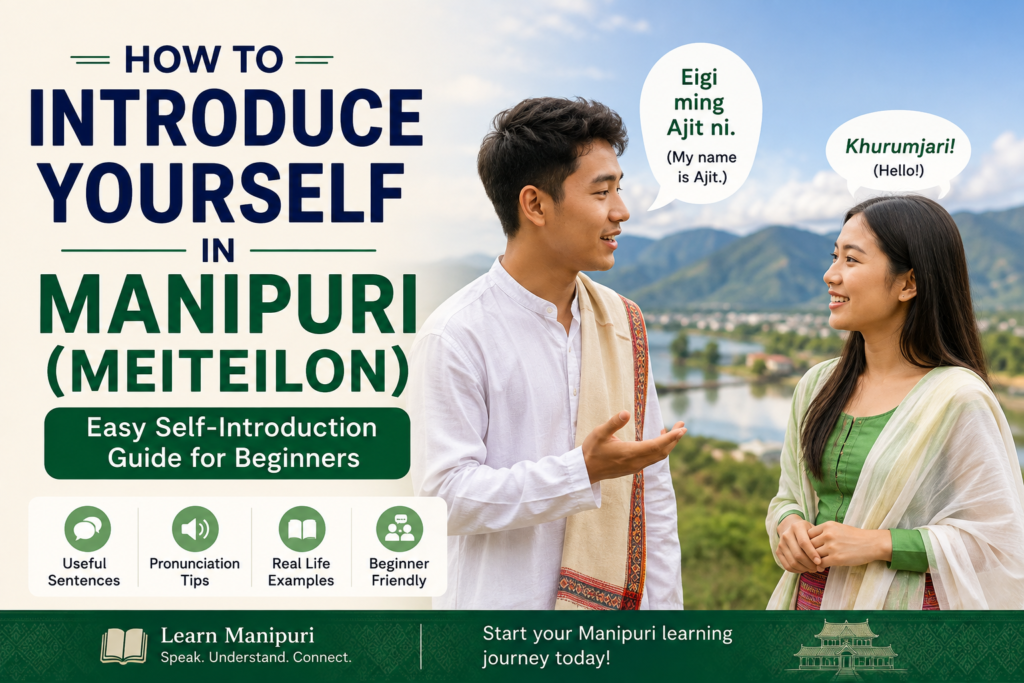
| My name is Ajit. | Eigi ming Ajit ni. |
| What is your name? | Nanggi ming kari no? |
| I am from Manipur. | Ei Manipurdagi ni. |
| Where are you from? | Nang kadaidagi ni? |
| I am a student. | Ei student ni. |
| I am learning Manipuri. | Ei Manipuri tamlibani. |
Daily Conversation
| English | Romanized Manipuri |
|---|---|
| What are you doing? | Nang kari toure? |
| I am working. | Ei thabak toure. |
| I am studying. | Ei tamlibani. |
| I am eating. | Ei chak chare. |
| I am drinking water. | Ei ishing pibire. |
| I am going home. | Ei yumda chatli. |
| Come here. | Masi lak-u. |
| Sit down. | Phambu. |
| Stand up. | Leiyu. |
| Wait a moment. | Khudongchaba ngairu. |
Asking Questions
| English | Romanized Manipuri |
|---|---|
| What is this? | Masi kari no? |
| Who is he? | Mahak kanano? |
| Where is the market? | Keithel kadaida leire? |
| How much is this? | Masi kari maram oiramge? |
| Can you help me? | Nangna eibu mateng pangbigadra? |
| Do you understand? | Nangna khangdre? |
| I don’t understand. | Ei khangde. |
| Please say it again. | Amuk haibiyu. |
Shopping Phrases
| English | Romanized Manipuri |
|---|---|
| I want this. | Ei masi pamba ni. |
| How much does it cost? | Masi kari maram oiramge? |
| It is expensive. | Masi maya yamna yaore. |
| It is cheap. | Masi maya yaroi. |
| Give me one. | Ama pibiyu. |
| Do you have another one? | Amuk leirabro? |
| Thank you. | Thagatchari. |
At Home
| English | Romanized Manipuri |
|---|---|
| Open the door. | Thangba hang-u. |
| Close the door. | Thangba thing-u. |
| Turn on the light. | Light hang-u. |
| Turn off the light. | Light thing-u. |
| Bring water. | Ishing purak-u. |
| Let’s eat. | Chak chanou. |
| Go to sleep. | Tumbu. |
At School
| English | Romanized Manipuri |
|---|---|
| Good morning, teacher. | Oja, khurumjari. |
| May I come in? | Ei lakpiyu? |
| Please explain again. | Amuk sandoknabiyu. |
| I don’t know the answer. | Ei khangde. |
| Thank you, teacher. | Oja, thagatchari. |
Travel Phrases
| English | Romanized Manipuri |
|---|---|
| Where is the bus stop? | Bus stop kadaida leire? |
| I want to go to Imphal. | Ei Imphal chatnaba pambi. |
| Which bus goes there? | Kari bus chatle? |
| Stop here, please. | Mapham asida lepkhiyu. |
| Thank you. | Thagatchari. |
Emergency Phrases
| English | Romanized Manipuri |
|---|---|
| Help me! | Eibu mateng pangbiyu! |
| I am sick. | Ei anire. |
| Call a doctor. | Doctor koubiyu. |
| I need medicine. | Ei dawa darkar oi. |
| Please call the police. | Police koubiyu. |
Common Daily Expressions
| English | Romanized Manipuri |
|---|---|
| Yes | Houjik |
| No | Natte |
| Maybe | Oigani |
| Of course | Houjik oigani |
| Really? | Tattana? |
| Very good | Yamna phajai |
| Good job | Phajabani |
| Congratulations | Yamnasing phajabani |
| Take care | Cheksin-u |
| Have a nice day | Numit phajabani oiyu |
Practice Tips
Learning everyday phrases is much more effective than memorizing individual words. Try speaking these expressions every day, even if you’re practicing alone.
Here are a few simple tips:
- Learn 5 new phrases every day.
- Repeat each phrase aloud 10 times.
- Practice with friends or family if possible.
- Watch Manipuri videos and listen for these phrases.
- Try replacing English with Manipuri in your daily routine.
For example:
- Instead of saying “Thank you,” say “Thagatchari.”
- Instead of saying “Hello,” say “Khurumjari.”
- Instead of saying “How are you?” say “Nang karamna leire?”
The more you use these phrases, the more natural they will become.
Everyday phrases are the key to speaking Manipuri confidently. By learning common greetings, polite expressions, shopping phrases, travel vocabulary, and daily conversations, you’ll be able to communicate in many real-life situations.
Practice these phrases regularly, listen to native speakers, and don’t be afraid to speak. Even a few simple sentences each day will help you improve your fluency over time.
At LearnManipuri.in, we’ll continue adding more Romanized Manipuri lessons, vocabulary, grammar, and conversation guides to help you become a confident Manipuri speaker.